

This is How We Teach – A Playful Introduction to Algorithms
This guide was created for our “Programming Logic for Preschoolers” – 12-week program. Our goal is to show you exactly how we help kindergarten-aged children playfully discover algorithms and master the logical foundations of coding.
👇 You can download one of the program’s sample games (which we’ll discuss in detail shortly) right here: 👇
Why start so early? Research proves that kids who learn to code at a very young age develop more advanced logical skills, and their brains are better wired for cause-and-effect relationships. Furthermore, they become more persistent, confident, creative, and better problem-solvers than their peers. Throughout the 12 weeks, they will experience firsthand that if they tackle a challenge and proceed step-by-step while constantly checking their work, their efforts will be crowned with success!
A few words about us: We launched LogicGecko in 2019 as a professional blog. During the quarantine period, we started creating and sending printable educational materials to our readers. We developed our 12-week coding logic program during 2021-2022, and in the first two years alone, 1,200+ parents and educators completed it with us across Europe. Based on their valuable feedback, we’ve perfected the program, which is now available in 5 languages.
Let’s Dive Into the Program!
As “Step Zero,” we introduced our custom-developed, code-following board game. The mission is simple: help a little dog find his bone because he forgot which pile of dirt he buried it under. We tested this game in three different ways:
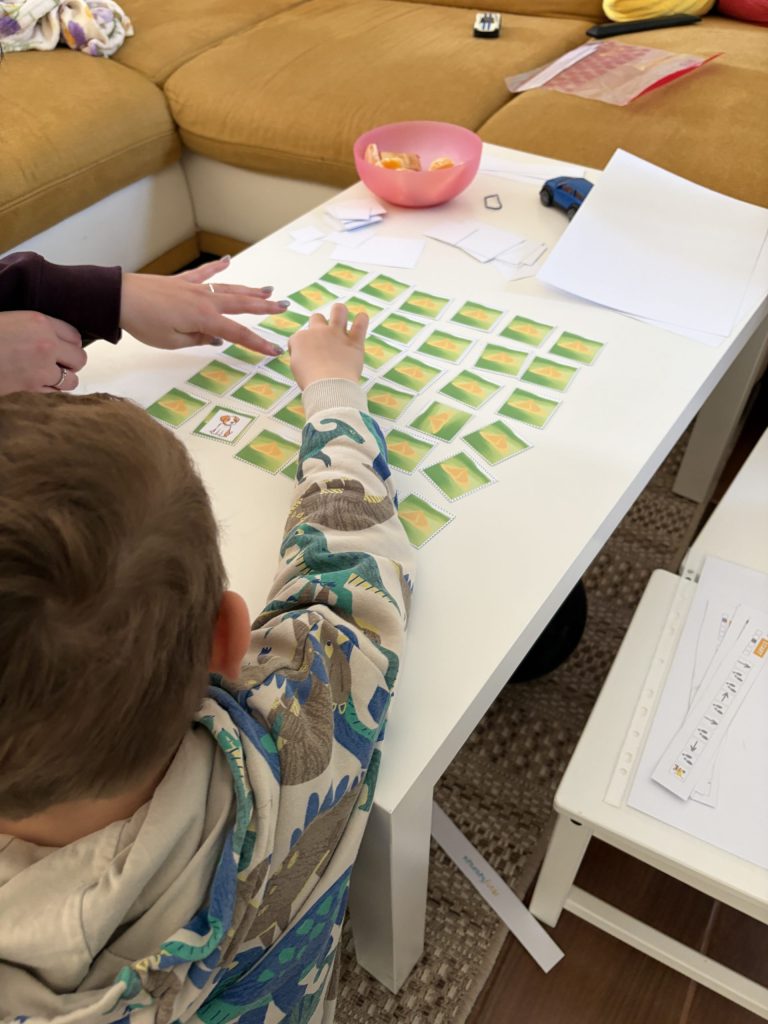
1. The Classic Gameplay: The child uses a provided sequence of codes to figure out exactly which card hides the bone. If there are multiple bones, they have to navigate through the correct fields in order.
2. Role Reversal (The Kids’ Favorite!): In this version, the kids hid the bone, and the parent had to find it. This worked perfectly because the child still had to calculate the correct card based on the code sequence to ensure they hid the bone in the right spot!
3. Free Play: The child designed the entire board, hid the bones wherever they wanted, and then navigated the parent (who was controlling the dog) using instructions. Practically, they were coding the desired path for us step-by-step.
During these fun sessions, the 5-6 year old kids were incredibly skillful. However, it also became clear that they weren’t quite ready to code an entire path from start to finish using just icons all at once.
The Goal of the Program
The main goal is to make them capable of exactly this, while developing a multitude of skills along the way. They will become much better at thinking in steps and sequences. They will navigate space more confidently, practice counting, and get familiar with numbers and logic.
The 12-week “curriculum” is roughly divided into two main phases:
Phase 1: Building the Foundation. During the first few weeks, we use a variety of fun, skill-building exercises to guide the kids. We teach them how to think in steps, maintain the correct order, check conditions, handle sequences and loops, and even find bugs.
Phase 2: Screen-Free Coding. At a certain point in the program, we transition to actual coding, and from then on, we rely primarily on unplugged, screen-free coding games.
Some of our games do have digital tablet versions, but these are always strictly optional, as we firmly believe in offline, hands-on experiences for this young age group. However, the dog-and-bone game, for instance, has a great tablet version that makes for a super, productive activity during a long flight or car ride!
Let’s look at the weekly themes!
Sequencing (Getting Things in Order)
Within algorithms, operations almost always follow a strict order. It’s a crucial logical foundation for children to grasp this concept clearly. That’s exactly why we dedicate the first week to practicing sequencing through countless fun games and activities.
One of our favorite exercises is mixing up the scenes of well-known stories and asking the kids to put them back into the correct order.
We provided custom illustrations for this, but we also let the kids draw the missing scenes themselves, or sometimes we just talked through the story verbally.
The main task was always the same: arrange the events in the right chronological order within the story.
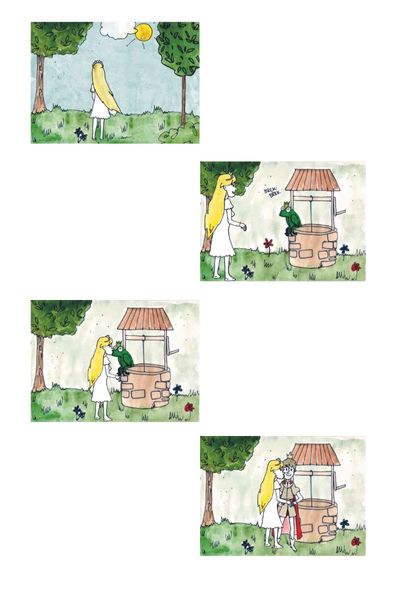
Fun fact from behind the scenes: We created so many original illustrations for just the first two worksheets that we could easily publish a children’s storybook! And since we developed this program back in 2021—long before the AI image boom—every single piece was drawn entirely by hand and digitized later.
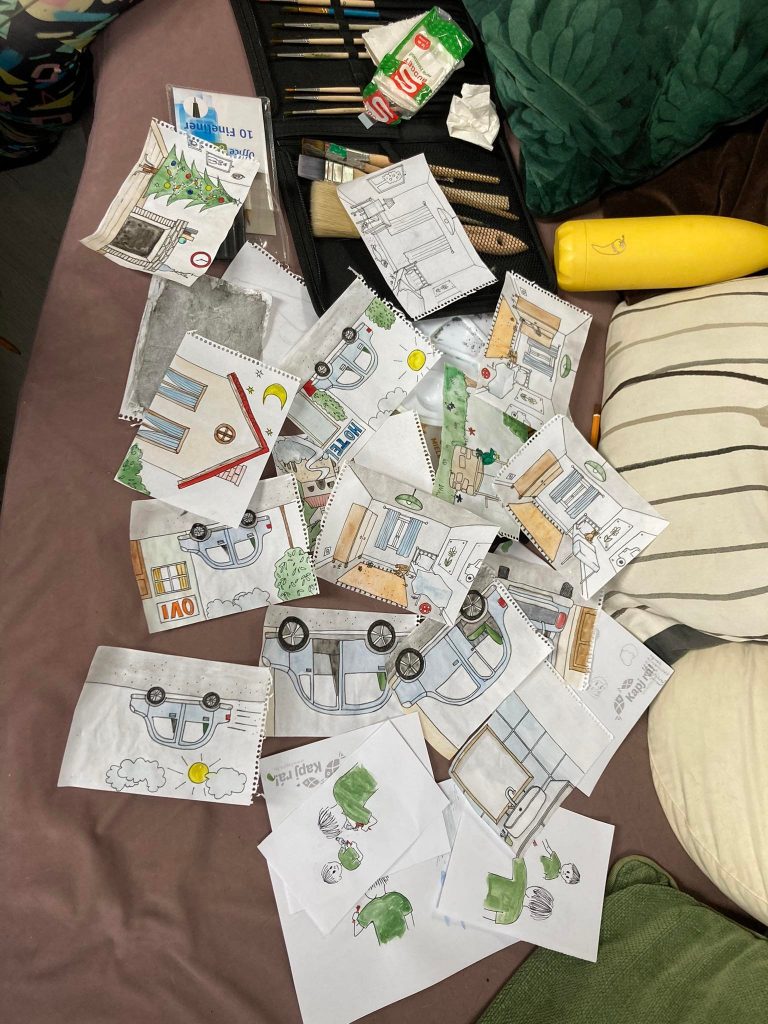
We made illustrations for these everyday activities too, so we could mix up the order and Tomi could put them back into the original order.
For the first two activity sheets, we made enough illustrations to make a whole storybook. We drew them by hand and digitised them afterwards.
Decomposition (Breaking It Down)
This is the process of breaking a complex operation into smaller, manageable sub-tasks. It is one of the most crucial areas of logical skill development.
There are two types of people: those who are terrified by a high school math equation, and those who aren’t.
Those who are scared see the equation as one massive, impossible task.
Those who aren’t scared see multiple small tasks: a simple division, then a subtraction, a multiplication, another division, and finally an addition. Since everyone knows how to add and divide, the equation loses its scary power.
If everyone could see the sub-tasks, math anxiety would plummet. Unfortunately, many of us aren’t great at decomposing tasks. The goal of this week is to ensure your child becomes a master at it. After all, great problem solvers are simply better at breaking things down!
When navigating the dog, they’ll learn not to try and dig up all the bones at once (that’s too overwhelming). Instead, they’ll focus on the closest bone first, then the next one, and so on. We practice this using everyday routines they already know—like vacuuming, brushing teeth, or washing dishes—but thinking about them in much greater detail than ever before.
Checking Conditions (If… Then…)
In both real life and computer science, most algorithms contain operations tied to conditions. If it rains, we take an umbrella. If it’s cold, we wear a coat. If it’s Saturday, we sleep until noon (well, some of us do!).
In the digital world, you only see my Facebook post IF we are friends. In one of our unplugged coding games, you can only step on a specific square IF it’s not covered in LAVA. To win the game, kids have to master this logical foundation. We probably created the most games and activities for this specific “lesson” because the possibilities are endless. Every sorting task and every “If this…, then that…” challenge is a perfect way to practice!
Creating Blocks (Functions)
There are sequences of actions we know so well and perform so routinely that we give them their own specific name. In computer science, these are called functions, and their purpose is to make the code simpler and more transparent.
In everyday life, an example is “going to kindergarten.” We don’t say: “We get in the car, turn left, go to the main road, take a right, drive to the next street, and pull over.” Instead, we just use one simple block: “We are going to kindergarten.” We teach kids how to group these familiar steps into single, easy-to-use commands.
Loops (Repetition)
We talk about loops when an operation or a block of operations needs to be repeated.
Sometimes we have a specific number of repetitions in mind (e.g., telling the dog to step forward exactly three times).
Other times, we have to repeat an action until a certain condition is met (e.g., keep making sandwiches until the cheese runs out, or keep walking forward until you hit a wall).
We’ve designed some incredibly fun coloring challenges specifically to help kids grasp this concept! 🙂
Debugging (Finding the Mistakes)
In the tech world, this simply means hunting for bugs. But in reality, whenever you’re solving any problem, it’s a massive advantage if you can systematically check yourself and your work.
We invented several hilarious games to practice this, but the most memorable one was when the child had to find the “bug” in their parents’ outfits. Dad put on something that belonged to Mom, and vice versa—and the kid had to identify the glitch in the system! This resulted in so much shared laughter, making it one of our absolute favorite activities. 🙂
Following Algorithms
At this point in the program, we finally reach algorithms! The child doesn’t write them just yet; we simply follow the instructions. First, we follow commands in everyday human language, and then we introduce character sets—where arrows, pictures, and simple icons convey the instructions instead of words.
Hunting for Bones… Again!
This is when we bring back our beloved bone-hunting dog game! By this week, kids usually reach the point where they can confidently guide the dog using only the icon character sets.
Using loops is no longer a problem, and they skillfully handle counting the steps.
They naturally decompose the task, meaning they only try to navigate the dog to the closest bone first, rather than looking at the whole board at once.
Suddenly, what seemed like a complex coding challenge feels completely human, transparent, and incredibly simple! In the final weeks of the program, we introduce even more board games and exciting screen-free coding adventures.
Love what you see? Don’t stop here!
Join the 1,200+ parents who are already developing their child’s logical thinking with us—screen-free, full of laughter, and through shared playtime.
There is absolutely zero risk: We offer a 14-day, 100% money-back guarantee on the program. If your little one doesn’t enjoy the games, we will refund your money, no questions asked.